
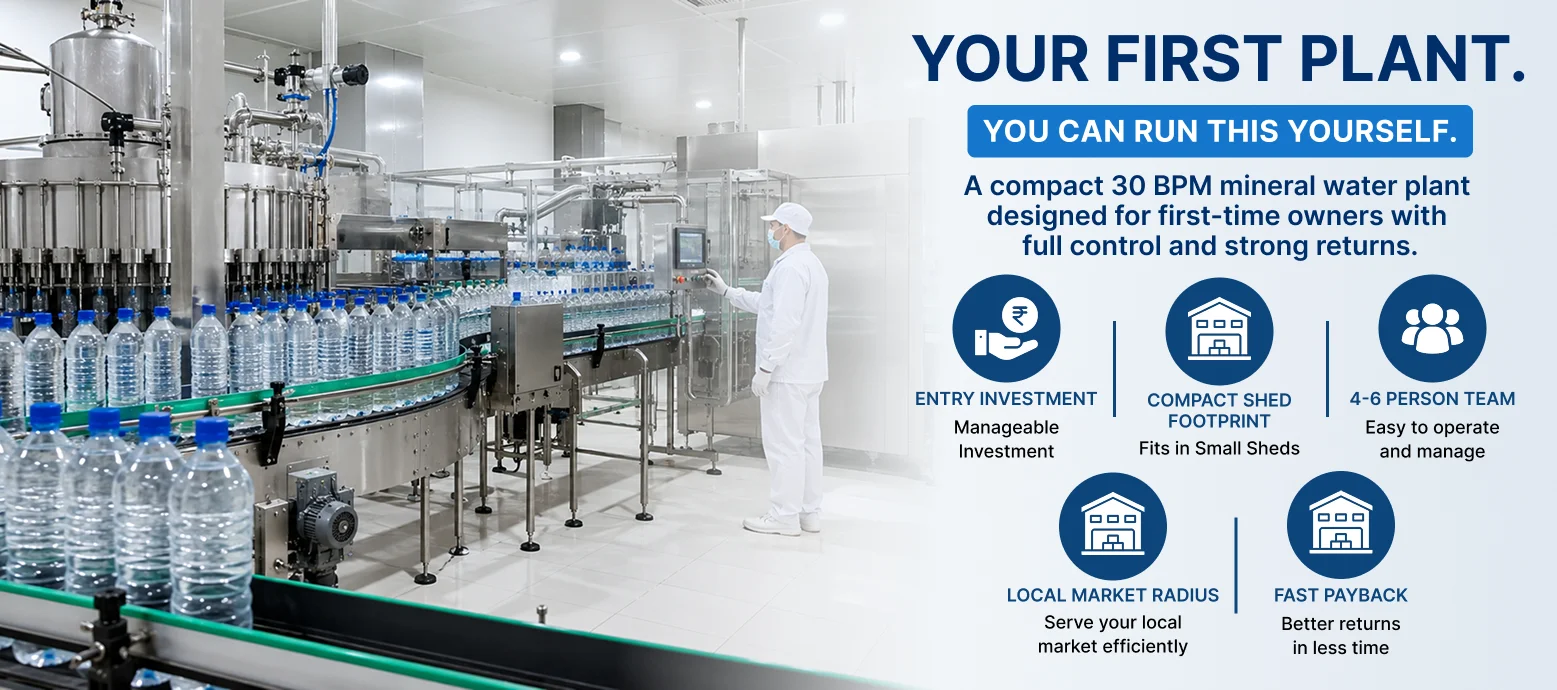
Most people who buy a 30 BPM plant are doing this for the first time. A shopkeeper’s family with a plot behind the house. A farmer who has watched tanker water sell in his town for years and finally decided to bottle it himself. It also suits the jar-water supplier or trader who wants to test manufacturing before betting serious money on it.





| Machine / Project | 30 BPM |
|---|---|
| RO Plan capacity (in LPH) | 2000 / 3000 |
| Automatic Blow Molding Machine (in BPH) | 1800 |
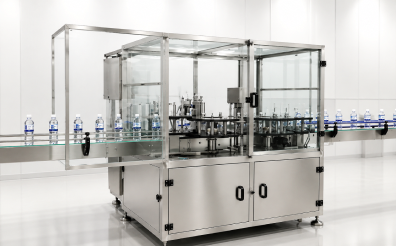
| Automatic Water Bottle Rinsing Filling and Capping Machine (RFC) (in BPM) | 30 |
| Automatic Batch coding Machine | Ink Jet |
| Automatic BOPP Labelling Machine (In BPM) | 60 |
| Automatic Shrink Wrapping Machine (In BPM) | 60 |
| Advance Technologies | |
| Added Mineral Technology | As per Capacity |
| Silverisation Technology | As per Capacity |
| Spring Technology | As per Capacity |
| Oxygen Maker Technology | As per Capacity |
| Alkaline Technology | As per Capacity |
| B12 Technology | As per Capacity |
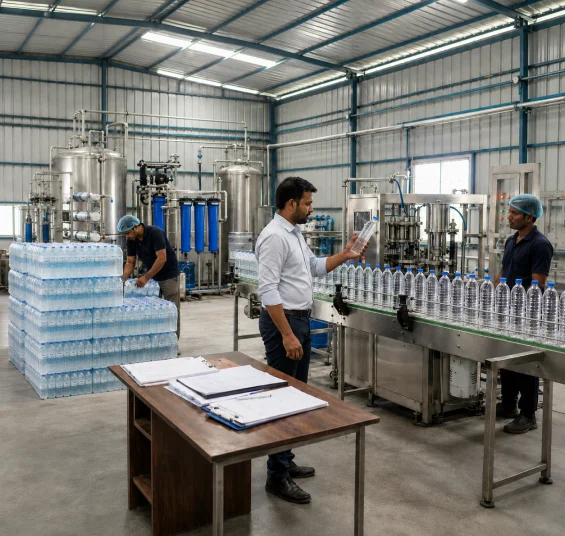
Equipped with a 2000–3000 LPH RO Plant to ensure a continuous supply of purified water for uninterrupted production.
Integrated Automatic Blow Molding Machine with a capacity of 1,800 bottles per hour (BPH) for efficient in-house bottle production.
Advanced Automatic Bottle Rinsing, Filling & Capping (RFC) Machine processes up to 30 bottles per minute, ensuring hygienic and precise filling.
Includes Automatic Inkjet Batch Coding, 60 BPM BOPP Labeling, and 60 BPM Shrink Wrapping Machines for fast, accurate, and professional packaging.

Fully synchronized automation minimizes manual intervention, improves production efficiency, maintains consistent quality, and reduces operating costs.
Three capacities, one real question: how sure are you about demand? Everything else — land, team, financing — follows from that answer. Read the rows below the way we’d walk you through them across a table, then read the verdict. It is blunter than a brochure would be, on purpose.
| What matters | 30 BPM | 40 BPM | 60 BPM |
|---|---|---|---|
| Who it suits | First-timer testing local demand; family deploying idle land | Buyer with measured survey numbers, or a trader with existing off take | Founder committed to a district brand; distributor with a network waiting |
| Your daily role | You run everything yourself – production, sales, collections | Still owner-run; your first real hire is a shift-in-charge | Owner-manager. You run the business, a team runs the machine |
| Realistic market | One town or taluka, sold on your face and phone number | Home town plus a cluster of near by towns | A full district through a working distributor network |
| Selling channel | Direct retail only – and that’s a strength, not a limitation | Direct retail with the first small dealers appearing | Distributor economics finally work; stockists stay interested |
| Financing route | Family capital; a small loan at most | Self-funded or small bank loan, with seasonal working capital | First proper bank project: DPR, term loan, WC limits |
| Land and setup | Modest shed or rented industrial gala | Slightly larger shed with clean separation of areas | Planned industrial shed with real warehousing |
| Licensing weight | Light scrutiny; we hand-hold ISI and FSSAI fully | Same support, growing paperwork | A district brand attracts inspection; systems begin here |
| The sign you’ve outgrown it | Refusing orders in your first summer | Reorders straining the line through the year | Distributor pull spilling beyond one district |

Start smaller, learn the market at lower investment, and validate real local demand before expanding.

Choose this when counters, towns and expected sales have been evaluated and you need more production headroom.

Best suited when you already have distribution strength, recurring buyers or a market ready to absorb higher output.

Whichever capacity you choose, ask us to lay out the plant so the next upgrade can be accommodated without major reconstruction.



albania

algeria

american samoa

angola

anguilla

antigua and barmuda

argentina

armenia

aruba

australia

austria

azerbaijan

bahrain

barbados

belarus

belgium

belize

benin

bermuda

cameroon

democratic republic of congo

egypt

gabon

ghana

kenya

liberia

nigeria

qatar

rwanda

saudi arabia

south africa

UAE

uganda
A 30 BPM Mineral Water Plant is a packaged drinking water production system designed for a nominal filling capacity of 30 bottles per minute. It integrates essential water treatment, purification, filling, and packaging processes required for commercial bottled-water production. The plant is well suited for entrepreneurs targeting a focused local or regional market. Its comparatively compact production scale makes it suitable for businesses starting with controlled investment and infrastructure. DTPPL provides complete technical solutions, installation support, and operator training for the 30 BPM plant.
A 30 BPM plant is ideal for first-time packaged drinking water entrepreneurs, family-owned businesses, local water suppliers, jar-water distributors, traders, and businesses entering a new market. It is particularly suitable when the initial sales territory is concentrated around a town, taluka, or nearby region. The capacity allows the owner to maintain close control over production and distribution without requiring a large management structure. It can also be used to establish a bottled-water business before considering future capacity expansion. DTPPL can help assess the technical requirements based on the proposed business model.
The treatment configuration is determined primarily by the quality of the available raw water. Depending on the source and water parameters, the treatment system may include filtration, activated carbon filtration, micron filtration, RO, UV, ozonation, and other required treatment stages. A water-quality analysis should be carried out before finalizing the treatment process. DTPPL designs the treatment system according to the site’s raw-water characteristics and required product quality. This helps ensure an appropriate and efficient purification process for the 30 BPM plant.
A 30 BPM plant can be planned within a comparatively compact industrial facility, provided adequate space is allocated for treatment, filling, packaging, utilities, storage, movement, and hygienic operations. Depending on the equipment configuration and automation level, a small team of trained operators can manage the production process. Approximately four to six people may be suitable for a compact operation, subject to the final plant configuration and working schedule. DTPPL provides operator training to help the team understand plant operation and routine procedures. The final space and manpower requirements should be confirmed after the equipment layout is finalized.
A packaged drinking water project must comply with applicable food safety, product quality, water-source, environmental, industrial, and local statutory requirements. Depending on the location and source of water, this may involve requirements related to FSSAI, BIS/ISI, groundwater permissions, pollution control, local authorities, and other applicable regulations. The exact approvals depend on the project location, water source, and applicable regulations at the time of establishment. DTPPL can provide technical guidance regarding plant-related requirements and documentation. Entrepreneurs should obtain the necessary approvals before commencing commercial production.
Yes, the 30 BPM Mineral Water Plant can be planned according to factors such as raw-water quality, bottle size, production requirements, site conditions, automation level, and packaging configuration. The water treatment stages should be selected based on actual water analysis rather than using an identical system for every installation. Equipment arrangement can also be planned according to the available plant area. DTPPL evaluates these requirements while developing the appropriate plant configuration. This ensures that the 30 BPM solution is aligned with the specific operating conditions of the project.
Yes, future expansion can be considered when planning the initial 30 BPM facility. The plant layout, utilities, infrastructure, and equipment positioning can be planned with potential capacity enhancement in mind. This approach can make a future upgrade more convenient and help minimize major modifications to the facility. It is particularly useful for businesses expecting their local bottled-water demand to grow over time. DTPPL can discuss an expansion-oriented layout during the initial plant planning stage.
Yes, a 30 BPM plant can be suitable for supplying packaged drinking water to kirana stores, hotels, restaurants, caterers, offices, schools, event venues, and other local commercial customers. It is particularly appropriate when the business serves a concentrated geographic area and has manageable recurring demand. Entrepreneurs should consider customer volumes, bottle sizes, delivery distances, seasonal demand, packaging costs, and distribution requirements before finalizing production targets. A focused local sales network can help the plant operate efficiently at this scale. DTPPL can configure the plant according to the intended production and market requirements.
DTPPL offers technical solutions for setting up a 30 BPM Mineral Water Plant, including plant planning, water-treatment system selection, equipment integration, installation support, and operator training. The solution can be developed according to the raw-water characteristics, site conditions, production requirements, and intended market. DTPPL also provides guidance to help first-time entrepreneurs understand the technical aspects of packaged drinking water production. Future expansion requirements can be considered during the initial plant-layout planning. This makes DTPPL a suitable technology partner for businesses establishing a 30 BPM packaged drinking water facility.